Why durability is not an environmental topic, but a question of emotional need.
There was a question I could not answer well for a long time.
When did you last cry over something that broke?
Not an expensive thing — just an object that had been with you long enough to become part of you, your life, your rituals: the mug you used every morning, the chair you worked in, the rug that was the right one.
When that object breaks or disappears, it gets replaced with a new one — but something else disappears with it. Something hard to put into words.
It is a relationship.
We don't talk about objects the way we actually live with them
Today's consumer culture speaks about objects in two languages: price and function. If a thing is cheap enough and does its job, all is well. When it wears out, it is replaced. Simple.
But that does not describe how we actually live with things.
Psychologists have studied a phenomenon called the endowment effect: a person values an object they own two to three times higher than an identical object they do not own. Not because it is objectively better, but because it is theirs. A relationship has formed.
That relationship does not appear in an instant. It grows through time, use, touch and memories — through the object being where it should be, and exactly as it is, every time.
A mass-produced object that loses its face within the first season never reaches that stage. It is replaced before the relationship can form.
Patina* is not a sign of wear — it is proof of a relationship
Western culture holds a silent assumption that is rarely said out loud, yet drives almost every purchase: worn things are poor people's things. New is a sign of success. Flawless is valuable. Repaired is shameful. That assumption is relatively young. And it is wrong.
Look at what happened with Japanese boro textiles — hand-repaired cloth, patched from generation to generation, once considered a mark of poverty. Today authentic boro pieces sell in galleries for thousands of dollars. Not as irony, but because their value has finally become visible: they carry something a new object cannot offer — time, craft, stories.
The same shift has happened everywhere wealth is old enough to have outgrown the cult of the new. The English aristocracy does not replace its antique furniture, it restores it. Old Italian family villas are not renovated into modernism — their patina is their value. The Japanese upper class does not consider kintsugi, ceramics repaired with gold, a cheap fix. It is an art form.
Worn and repaired things are not poor people's things. They are people's things — belonging to those who have lived long enough to understand that a relationship with an object cannot be bought, only allowed to happen.
Think about it: why is your grandmother's handiwork, an old farmhouse table or your father's tool something you never throw away, even when it is „worn out“? Not out of sentimentality, but because those objects carry a story. Their imperfection is proof that someone touched them, used them, lived beside them.
That is a value a new object cannot offer. And a value that wealth always ends up recognising.
Sashiko: repair that does not hide
There is a concept in Japanese tradition that describes exactly what Western culture struggles to understand.
Sashiko means literally „little stabs“. It is a 17th-century art of textile repair that was truly born from poverty: in the cold regions of northern Japan cloth was rare and expensive, throwing it away unthinkable. Worn fabric was repaired — but not so the repair would be invisible. On the contrary: according to sashiko philosophy the repair must not be hidden. Mending should be celebrated.
The stitched pattern is visible, the patch is in a contrasting tone, the tear is cleaned but left in place. The result is an object carrying its own history — every stitch proof that someone valued it enough to invest time into it.
This is the exact opposite of what we do today. We hide wear. We swap an object out when it shows its age. We buy a new one because the old one „doesn't look good anymore“.
Sashiko says: what has been repaired is stronger than what has never broken.
Boro: an object that has lived several lives
Textiles repaired in the sashiko technique across generations are called boro in Japan — literally „rags“. Yet what is sold in galleries and collected as art today is exactly those rags.
A boro textile has been mended so many times that it has become a work of art in its own right — not by anyone's intention, but as a result of time and use. Each generation added its layer: a new patch, new stitches, a new shade of indigo. The result is a surface that speaks of decades and of dozens of people.
Mottainai, the Japanese term for regret over waste, is the core of the boro philosophy. An object is never „finished“. There is always something that can be continued.
Kintsugi: the broken place is the strongest place
If sashiko speaks about textile, kintsugi speaks about ceramics. It is perhaps the best-known Japanese philosophy of repair.
Kintsugi means „joining with gold“. When a ceramic object breaks, it is not thrown away. It is joined back together using natural urushi lacquer and gold powder. The result is an object where the break is visible, yet has become something more valuable than what existed before.
The core is simple: the broken place is part of the object's story. It does not need to be hidden. It should be marked.
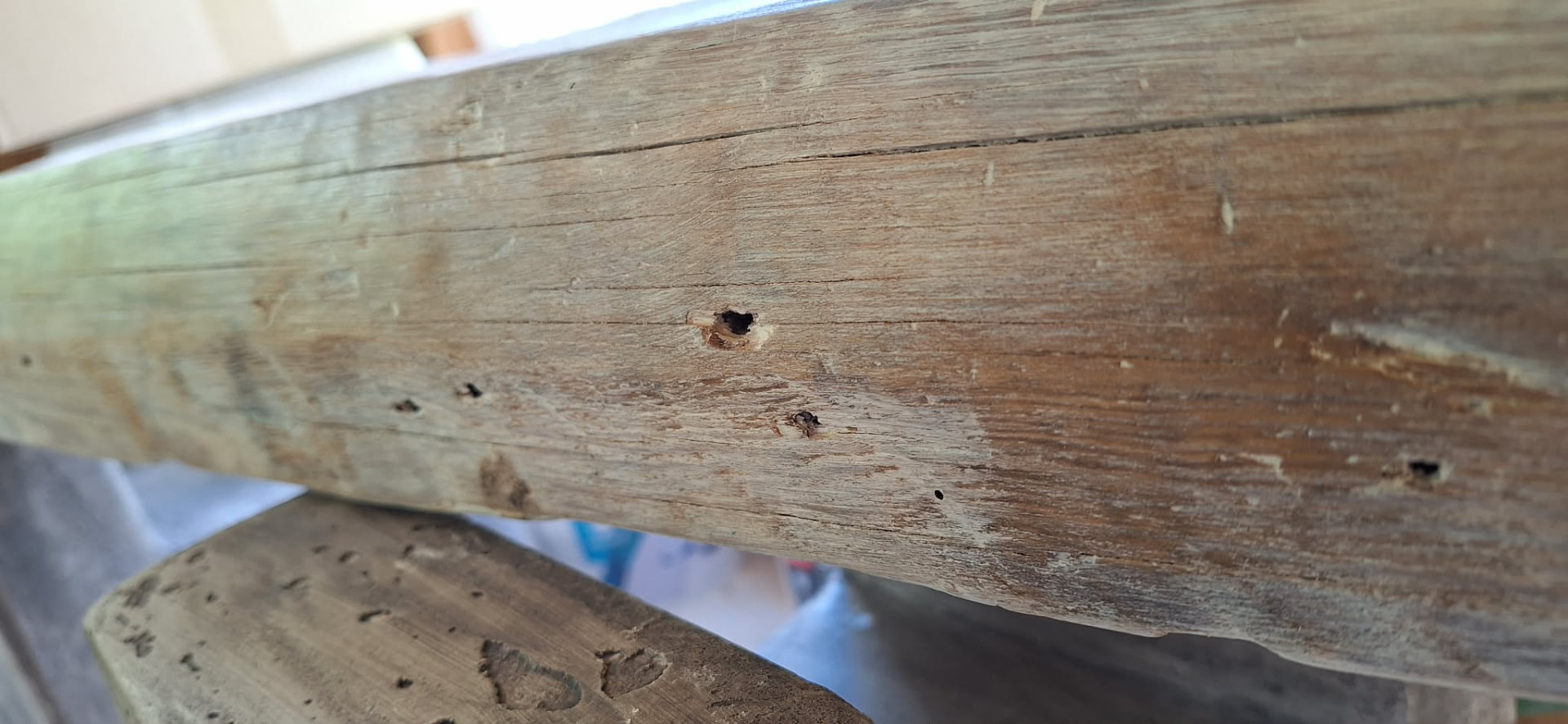
The same logic works with wood. A beam showing growth rings, knots and the traces of handwork is not „defective“. It is an object carrying its history, and every irregularity is proof that the material has lived.
Surfaces worn to a shine
There is a detail we rarely notice, but always feel.
An old wooden bench used for decades is worn to a shine exactly where people lean on it most. That is not the gloss of lacquer or polishing — it is a smooth, reflective surface created simply by use, over time.
It cannot be ordered and it cannot be accelerated. A factory sander can make a surface smooth in a minute, lacquer can make it glossy in a second, but the sheen that appears over decades through thousands of touches is something else entirely. It is not a finish; it is time itself, in material form.
Three parties create it together. The material — wood must be alive enough to respond; a densely lacquered or artificial surface stays the same forever. The person — every touch is a microscopic trace, the warmth and pressure of hands forming a pattern exactly where life has happened. And time — the one party that cannot be substituted, turning the sum of thousands of touches into something visible.
The Japanese writer Junichiro Tanizaki called this sabi: the patina of time, the highest form of beauty, because it cannot be faked. We live in an age where almost everything can be simulated. But a surface worn to a shine is proof that something really happened, that someone was here, that there was life here.
„The Japanese prefer not to polish silver and brass, but to let them patinate through time and use. When an object needs repair, it is done with a respect that comes from understanding that it has served a long and useful purpose.“
Junichiro Tanizaki, In Praise of Shadows, 1933. It is the exact opposite of the Western instinct to polish everything bright, make it new, remove the old.
What an object that lasts really means
An object that lasts twenty years is something entirely different from an object that lasts two. Not only materially, but emotionally.
An object that has been with you for twenty years has seen you in different stages of life. It was there when you moved, when you had a bad day, when you had a good day. It has become part of the memory of your space, part of the identity of your home.
Such a relationship cannot be bought — it can only be allowed to happen, by choosing an object made to last. Natural materials, craft and natural finishes are not merely aesthetic choices. They are choices that say: I want this object to stay with me long enough for us to build a relationship.
What is loved never enters the waste stream
There is one thing the circular economy discourse often forgets.
We do not throw away things we love. We throw away things we have no relationship with.
A durable object is not simply an object made of durable material. It is an object you bond with, one you do not want to part from. An object passed on to the next generation not because it is „too good to throw away“, but because it is part of the story.
That is the real meaning of sustainability. Not circulation, but relationship.
The article series „A space that speaks with you“ explores how materials, objects and spaces shape our wellbeing, memory and identity.
We already know this
Our grandmothers darned socks. Not because the socks were expensive, but because they had knitted them themselves, and to a grandchild those hand-knitted socks were dear not because they were good socks, but because they carried grandmother's handwork.
That is a relationship with an object in its purest form. The object itself is insignificant. But who made it, how it was made and whose hands shaped it — that is what turns an object into something you do not throw away.
We have not lost that wisdom; we have simply renamed it. Today we call it "the value of craft" and pay more for it. But the feeling is the same as ever: an object into which time, craft, love and care have been put is something more than just an anonymous thing.
* The word "patina" originally refers to the green layer that forms on copper and bronze. But the same word is used more broadly for the surface of any material — wood, leather, stone — that has become more beautiful through time and use. It is the memory of the material made visible.
See the benches made so a relationship has time to form: gallery or ask for a similar piece.